

 See My Latest Article on HelloNation
What makes a supercar fast?
A supercar’s speed comes from several systems working together: engine power, low weight, aerodynamic design, tire grip, braking control, and electronic systems that manage traction. No single feature explains the performance.
Acceleration depends on how quickly the vehicle can produce useful force at the tires. Top speed depends more heavily on engine output, gearing, aerodynamic drag, and the vehicle’s ability to remain stable at high speed.
For residents examining performance vehicles in everyday conditions, the key point is that a supercar’s capabilities are designed for controlled environments. Public roads rarely provide enough space, visibility, or legal opportunity to explore the upper limits of the vehicle.
How does engine power become acceleration?
The engine produces torque, which is twisting force. The transmission uses different gear ratios to multiply that force and deliver it through the driveshafts, differentials, and axles to the tires.
Horsepower describes how quickly the engine can perform work. Torque helps the vehicle begin moving and respond strongly at lower speeds, while horsepower becomes especially relevant as speed increases.
A simplified relationship is:
- More engine torque can help produce stronger initial acceleration.
- More horsepower can help maintain acceleration at higher speeds.
- Lower vehicle weight allows the same power to move the car more effectively.
- Appropriate gearing keeps the engine operating in a productive range.
This is why two vehicles with similar horsepower can perform differently. Their weights, gear ratios, tire compounds, drivetrain layouts, and electronic controls may not be the same.
Why does lower weight matter so much?
A lighter car requires less force to accelerate, stop, and change direction. Reducing weight also helps the suspension control the vehicle because there is less mass moving through corners, over bumps, and during braking.
Supercar manufacturers may use lightweight metals, carbon-fiber panels, compact components, and carefully designed interiors to reduce mass. These materials can be expensive and complex to manufacture, but they improve several areas at once.
Weight distribution matters as well. A vehicle with its mass positioned close to the center can respond more predictably during cornering. Engineers also try to control the balance between the front and rear axles so the tires can share braking, acceleration, and cornering duties effectively.
How do tires affect supercar performance?
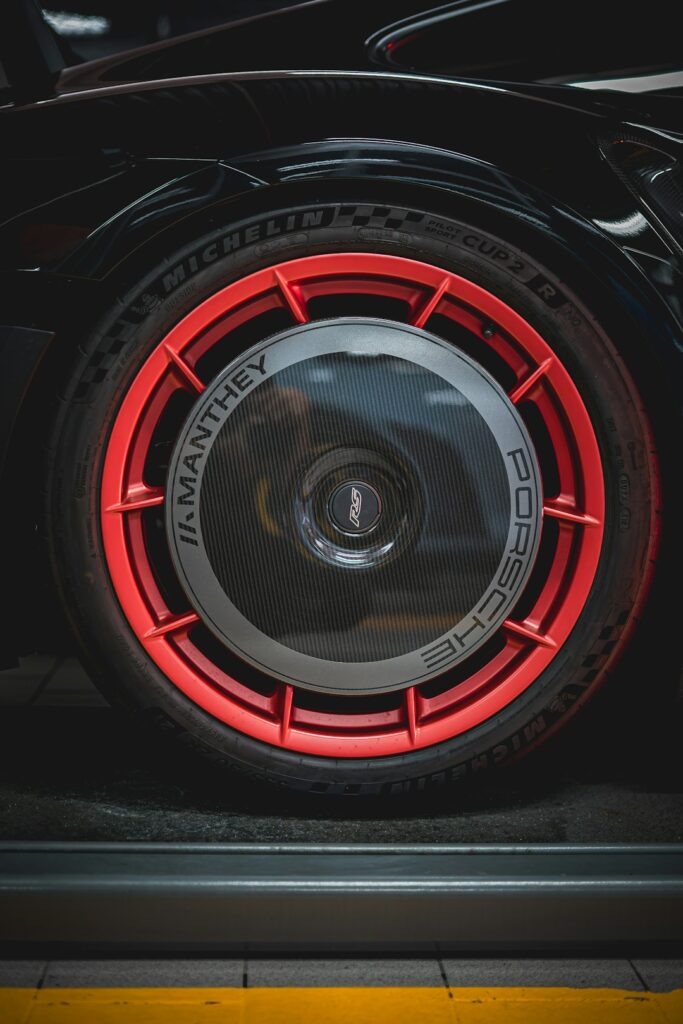
Tires are the only parts of the vehicle touching the road, so they determine how much of the engine’s power can actually be used. A powerful engine cannot accelerate the vehicle efficiently if the tires lose grip.
Grip is affected by:
- Tire compound and temperature
- Tread design
- Tire width and construction
- Road surface texture
- Rain, standing water, sand, and debris
- Tire pressure and vehicle load
Performance tires are designed to generate high levels of grip under suitable conditions, but they may behave differently during heavy rain or cooler weather. In Boynton Beach, FL, sudden rain, humid conditions, and wet pavement can reduce available traction even when the road appears clean.
A modern traction-control system monitors wheel speed and can reduce engine power or apply braking when a tire begins to spin. This improves stability, but it cannot create grip that the road surface does not provide.
What role does aerodynamics play?
Aerodynamics controls how air moves around and under the vehicle. At higher speeds, air resistance becomes one of the largest forces working against forward motion.
Engineers use smooth body shapes to reduce drag. They may also add wings, splitters, diffusers, and carefully shaped underbody panels to create downforce. Downforce pushes the vehicle toward the road, helping the tires maintain contact during fast cornering and braking.
There is a tradeoff. More downforce can improve cornering stability, but it usually creates additional drag. A design focused on maximum top speed may use less aerodynamic resistance, while a design intended for track performance may accept more drag in exchange for greater grip.
These aerodynamic features are most useful at speeds that are not appropriate for ordinary public roads. Their presence does not mean the vehicle is safer to drive aggressively in traffic.
Why can some supercars launch so quickly?
Rapid launches depend on traction, power delivery, transmission response, and electronic control. All-wheel-drive systems can send power to more than two tires, which may help reduce wheelspin during acceleration.
Launch-control systems coordinate engine speed, clutch engagement, gear changes, and traction management. The system aims to provide strong acceleration without allowing the tires to spin excessively.
A launch on a prepared track is very different from accelerating on a public street. Road surfaces may contain painted markings, sand, water, uneven pavement, or small pieces of debris. These conditions can make the vehicle behave differently from its advertised performance figures.
Why are brakes just as important as horsepower?

A fast vehicle needs a braking system capable of repeatedly converting motion into heat. Brake discs, pads, calipers, cooling ducts, and electronic controls all contribute to stopping performance.
Carbon-ceramic brakes, where equipped, can tolerate high temperatures and repeated hard use. However, even advanced brakes require suitable tires and pavement. Stopping distance also depends on reaction time, road conditions, vehicle load, and speed.
Speed has a particularly strong effect on stopping energy. When speed doubles, the vehicle carries roughly four times as much kinetic energy. That is why a small increase in speed can produce a much larger increase in braking demand.
On local roads, traffic signals, driveways, pedestrians, cyclists, wet pavement, and unexpected vehicles create hazards that high-performance braking systems cannot eliminate.
How do suspension and steering help a supercar corner?
The suspension keeps the tires connected to the road while controlling body movement. Springs support the vehicle, dampers manage bouncing, and anti-roll components limit excessive leaning during turns.
Some high-performance vehicles use adjustable suspension systems that alter damping, ride height, or stiffness. Steering systems may also change their response depending on the selected driving mode.
A firm suspension can improve control on a smooth track but may feel less comfortable on uneven pavement. In a residential area, a low front splitter or reduced ride height may also be more vulnerable to steep driveway transitions, raised pavement, and drainage features.
That practical limitation is easy to overlook: engineering designed for speed can require more care during ordinary low-speed driving.
Does hot, humid weather affect performance?
Yes. Heat affects air density, tire temperature, engine cooling, brake temperature, and driver comfort.
Warmer air contains less oxygen per unit of volume than cooler air. Modern engine computers compensate for changing conditions, but extreme heat can still influence power output and cooling demand. Hot pavement can also raise tire temperatures, while heavy rain can sharply reduce traction.
Humidity itself is not usually the only concern. The combined effects of heat, direct sunlight, wet roads, standing water, and frequent stop-and-go traffic matter more in daily driving.
Regular checks of tire condition, fluid levels, brake behavior, warning lights, and cooling performance are especially relevant for high-output vehicles used in a warm coastal climate.
Is a supercar’s advertised top speed useful in daily driving?
Top speed is mainly an engineering measurement, not a practical driving target. It reflects the balance between power, gearing, aerodynamic drag, tire capability, and stability under controlled conditions.
For everyday travel, more useful measures include:
- Smooth low-speed control
- Predictable braking
- Visibility around the vehicle
- Comfortable suspension behavior
- Reliable cooling in traffic
- Tire performance in wet conditions
- Clearance for driveways and uneven pavement
The science behind supercar speed is impressive because multiple systems must operate as one. The same principles also explain why responsible driving matters: power, grip, and braking are limited by the road, the weather, the vehicle’s condition, and the decisions made behind the wheel.