

 See My Latest Article on HelloNation
What does aerodynamics mean for a supercar?
In Boynton Beach, FL, a supercar’s performance depends on more than engine output, tire grip, and suspension tuning. Aerodynamics determines how air moves around, under, and through the vehicle, influencing stability, acceleration, braking, cornering, cooling, and efficiency.
At low speeds, aerodynamic forces are modest. As speed rises, they become much more significant because aerodynamic force increases rapidly with velocity. This is why a supercar can feel stable and composed at highway speed yet become highly sensitive to airflow, crosswinds, or body changes at much higher speeds.
The central design challenge is balancing downforce against drag. More downforce can improve tire grip, but it usually creates more resistance through the air.
How does downforce help a supercar corner?
Downforce pushes the car toward the pavement without adding physical mass. That extra aerodynamic load increases the force available between the tires and road surface, helping the vehicle accelerate, brake, and turn more effectively.
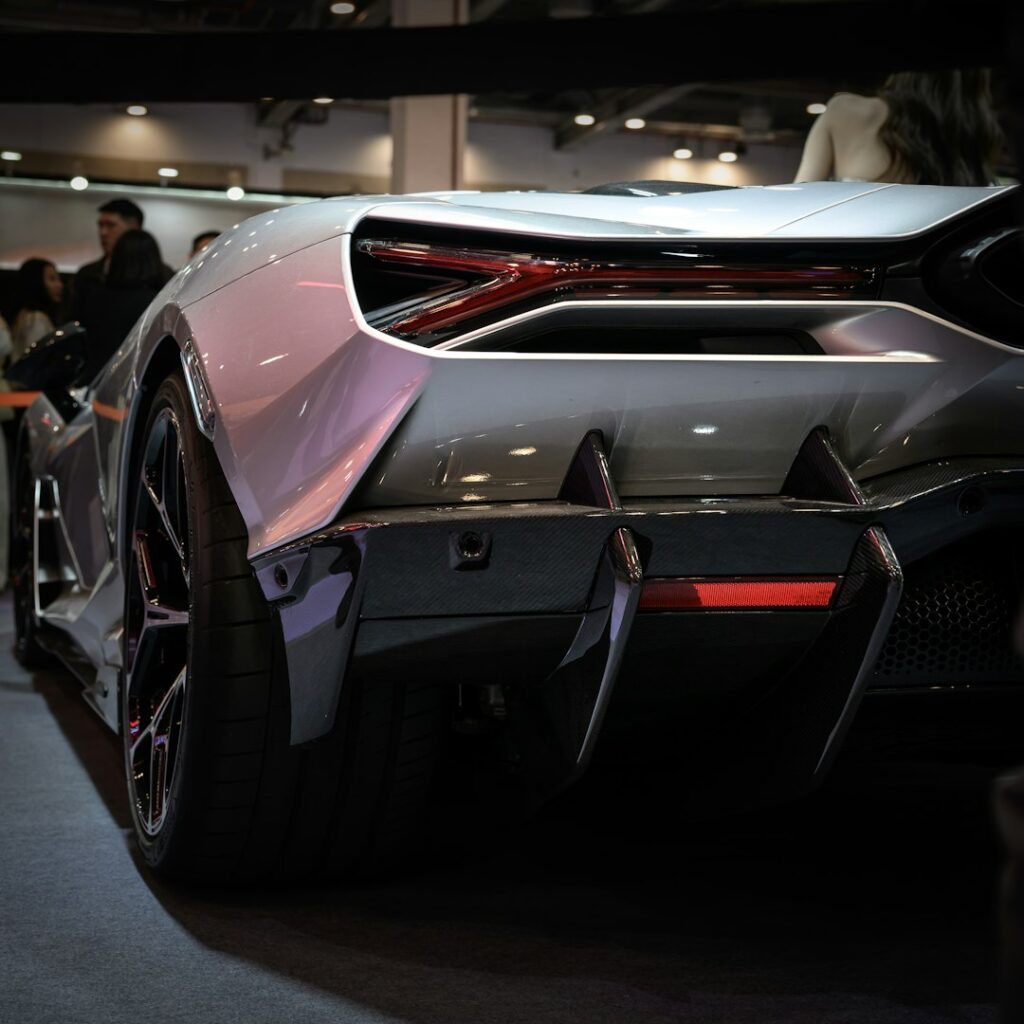
A supercar may generate downforce through several features:
- Front splitters that manage airflow beneath the nose
- Flat underbody panels that smooth air beneath the chassis
- Diffusers that help accelerate and expand airflow under the rear of the car
- Rear wings or active spoilers that redirect air upward, creating a downward force
- Vents and channels that reduce pressure in wheel wells and other turbulent areas
The benefit is most noticeable during fast cornering. A car with effective aerodynamic balance can remain more firmly planted, with less body movement and more predictable steering response.
Downforce does not eliminate the limits of the tires. If the road is wet, sandy, oily, or uneven, available grip can still be reduced. Additional aerodynamic load is useful only when the tires and suspension can convert it into controlled traction.
Why does more downforce also create more drag?
Downforce and drag are closely connected. Surfaces that redirect air downward or create a pressure difference around the vehicle often increase resistance to forward motion.
Drag reduces acceleration at higher speeds and can lower top-speed potential. It also requires more power to maintain speed, which may increase energy use and heat production.
This creates different aerodynamic priorities for different driving conditions:
- A track-focused setup may accept more drag to gain cornering grip.
- A highway-oriented setup may use smoother surfaces and less aggressive wings.
- An active aerodynamic system may change its position depending on speed, braking, acceleration, or steering input.
A low-drag configuration can help a car reach a higher top speed, but reducing drag too aggressively may also reduce stability. The best design is not necessarily the one with the least drag or the most downforce. It is the one that maintains a useful balance across the intended speed range.
What is the difference between lift and downforce?
Lift is an aerodynamic force that acts away from the road. In an aircraft, lift is useful because it supports the aircraft in the air. For a road car, unwanted lift can reduce tire loading and make the vehicle feel light or unsettled at speed.
Downforce is aerodynamic lift directed toward the pavement. Supercar designers use shaped bodywork to create pressure patterns that push the vehicle downward rather than upward.
The distribution of that force matters as much as the total number. If the front produces too little aerodynamic load compared with the rear, the car may feel vague or resistant to turning. If the rear loses stability relative to the front, the vehicle can become nervous during high-speed braking or corner entry.
Aerodynamic balance must work together with spring rates, dampers, ride height, tire construction, alignment, and electronic stability systems.
How does the underside of the car affect performance?
The underside often has a greater aerodynamic influence than casual observers realize. A smooth floor reduces turbulence and helps designers control the air moving beneath the vehicle.
A diffuser at the rear allows air under the car to slow and expand in a controlled manner. This can lower pressure beneath the chassis and contribute to downforce without relying entirely on a large rear wing.

Ride height is also important. Lowering the car can improve airflow control, but an extremely low vehicle may scrape over uneven pavement, lose underbody performance when the suspension compresses, or become less usable on ordinary roads.
In Boynton Beach, surface conditions can vary between smooth major roads, patched pavement, construction areas, and streets affected by heavy rain. A setup designed for a perfectly level circuit may not work as intended when the vehicle repeatedly encounters dips, drainage changes, or uneven surfaces.
Do spoilers always make a supercar faster?
No. A spoiler can improve stability and traction in some conditions while reducing top speed or increasing fuel and energy consumption.
A rear spoiler is not simply a decorative attachment. Its angle, height, width, and relationship to the rest of the body determine how it affects airflow. A poorly matched component may add drag without producing useful downforce. It can also disturb the aerodynamic balance between the front and rear axles.
Adding or removing exterior parts may alter cooling airflow, sensor operation, or stability-control calibration. Even small changes can have a larger effect at high speed than they do during ordinary street driving.
For road use, factory aerodynamic systems are generally engineered as part of the complete vehicle rather than as isolated accessories.
How do weather and road conditions change aerodynamic behavior?
Air itself changes with temperature, pressure, humidity, and speed. These changes are usually subtle during normal driving, but wet pavement and wind can have more noticeable practical effects.
Boynton Beach’s warm, humid conditions and frequent heavy rain can affect how a high-performance car feels on the road, especially when water collects in low areas or road surfaces become slick. Aerodynamics cannot compensate for reduced tire friction on standing water.
Rain can also change airflow around the body and increase resistance. Crosswinds may produce side forces, particularly on cars with large wings, deep splitters, or broad body surfaces. Drivers may notice this as a need for small steering corrections rather than as a dramatic loss of control.
The most useful response to poor conditions is to reduce speed smoothly, increase following distance, and avoid abrupt steering or braking. Aerodynamic grip is not a substitute for a dry, predictable road surface.
How does aerodynamics affect braking and acceleration?
During acceleration, drag becomes increasingly important as speed rises. At lower speeds, engine power and tire traction usually dominate. At higher speeds, the car must spend more of its available power pushing air aside.
During braking, aerodynamic downforce can increase tire loading and help the tires transmit braking force to the road. Some performance cars use active aerodynamic surfaces that move into a higher-drag position under heavy braking. This can help slow the vehicle while also maintaining stability.
The effect is speed-dependent. At city and ordinary highway speeds, brakes, tires, and road conditions generally matter more than the car’s most advanced aerodynamic features. The benefits become more pronounced during sustained high-speed driving or controlled track use.
Can a driver feel aerodynamic changes without seeing them?
Yes. A driver may notice aerodynamic effects as changes in steering weight, high-speed stability, cornering confidence, braking behavior, or sensitivity to crosswinds.
However, these sensations are not always caused by aerodynamics. Tire pressure, alignment, worn suspension components, uneven tire wear, road grooves, and wind direction can create similar symptoms.
A sudden change in stability should be treated as a possible mechanical or tire-related issue rather than assumed to be normal aerodynamic behavior. High-performance vehicles are especially sensitive to tire condition and suspension setup, so safe diagnosis may require inspection when handling changes unexpectedly.
Understanding aerodynamics helps explain why supercars use sculpted bodywork, but it also shows why performance is never produced by one component alone. The strongest results come from coordinating airflow with tires, suspension, brakes, power delivery, and the conditions of the road.